I remember leaning closer to my monitor during that digital press event for the Defiance update, the one where Respawn finally said the quiet part out loud. Apex Legends had been one of the few live-service shooters still running without a true current-gen version on PlayStation 5 and Xbox Series X|S. As someone who has sunk way too many hours into ranked, I was practically bouncing in my chair when the team teased a performance upgrade. No exact date, of course—just a very familiar "soon." That word does a lot of heavy lifting in this community, but I’ll take it.
The big question among my squad was simple: what would the PS5 and Xbox Series X|S update focus on? In a competitive shooter, frames are king. I’d take a locked 120 FPS over sparkly textures any day, but some of my friends with 4K TVs were hoping for crispier visuals. Respawn kept the details close to the chest, so we sat there arguing about frame rate versus fidelity like a bunch of backseat game developers. My money was on performance, but I wouldn’t say no to both. Honestly, the fact that we were even having the debate felt like progress.
Then the conversation shifted to Mad Maggie, and that’s where my ears really perked up. Respawn revealed that her abilities weren’t originally designed for her at all. They were cooked up for a Polish Legend named Hasaria, a SWAT-style cop who never made it out of the planning phases. Maggie basically inherited the kit and made it her own, which is such a Maggie thing to do. I remember laughing at that—of course the rebel warlord would grab someone else’s blueprint and run with it.
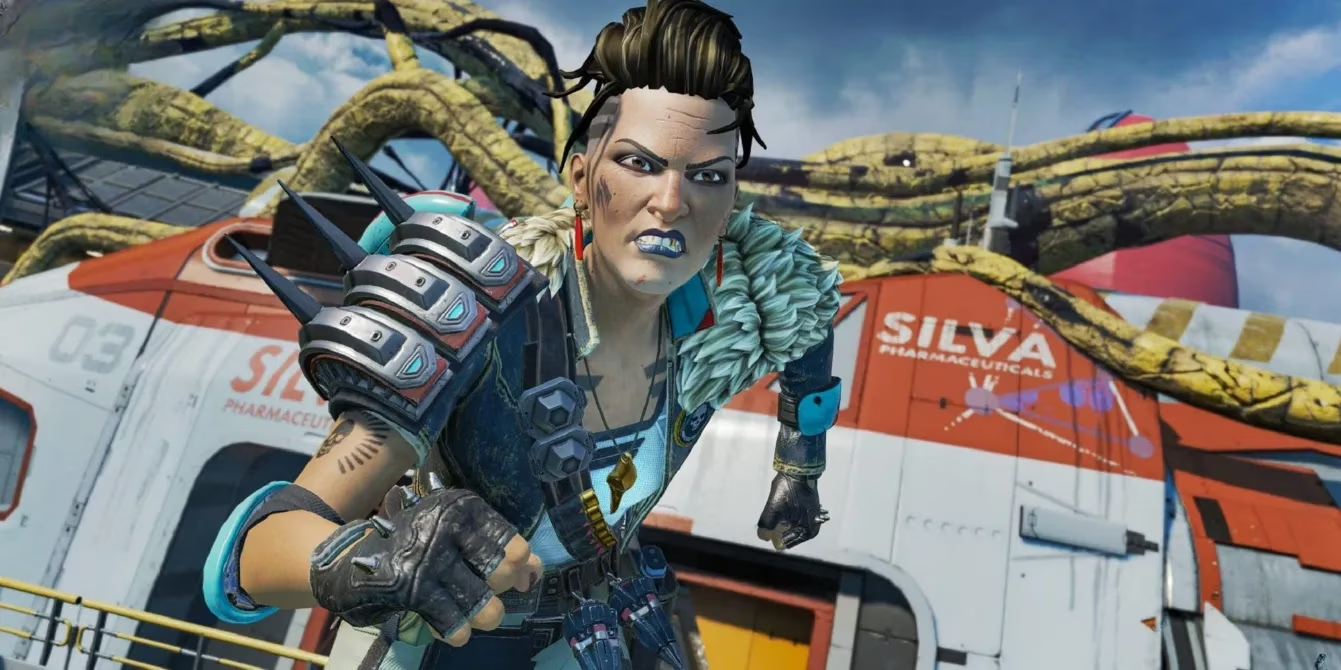
What really stuck with me, though, was the care Respawn put into Maggie’s Māori identity. Narrative lead Sam Gill explained that they worked with Māui Studios in New Zealand, specifically with Vincent Egan, to make sure Maggie felt authentic. I remember him saying, “It's really important that we work with a consultancy, with genuine Māori to make sure that [Maggie] is as authentic as possible, that she is someone that can be aspirational in her own way.” That quote hit me harder than a Peacekeeper headshot. Representation isn’t just about slapping a flag on a character or throwing a few traditional patterns into a skin. It’s about bringing in actual people from the culture to shape the story, the voice, and the personality. That is the kind of stuff that makes a character feel real.
Gill also talked about how Maggie and Fuse were originally supposed to be a lot friendlier. Their sibling rivalry slowly morphed into something more antagonistic until Respawn landed on the current narrative—Maggie feeling abandoned by Fuse. I love that tension. It makes their voice lines feel less like simple banter and more like two people who used to have each other’s backs but lost the thread somewhere along the way. It’s messy and human, even if one of them carries a giant wrench and the other keeps losing his arm.
For me, the Defiance press event was a turning point. It wasn’t just about a new season or a new Legend. It was a promise that the game I’d been playing on aging hardware would eventually get the current-gen treatment it deserved. The lack of a native PS5 and Xbox Series X|S version had been a sore spot for years, and hearing Respawn finally say something about it felt like a small victory. We didn’t know exactly when it would arrive, but for once, “soon” actually felt good.
Now, every time I load into the Outlands in 2026, I still think about that moment. The game has kept evolving, but that mix of technical hope and cultural storytelling is why I keep coming back. Frame rates might get me into a match, but it’s characters like Maggie—messy, proud, and authentically Māori—that make me stay.
The analysis is based on reporting from Game Developer (Gamasutra), a long-running industry outlet known for behind-the-scenes looks at how games are built; that lens helps frame Apex Legends’ “current-gen” discussion as more than a simple toggle—native PS5/Xbox Series X|S support typically involves platform-level optimization, performance targets like 120 FPS, and production tradeoffs that can influence everything from input latency to how consistently a live-service shooter can ship updates without breaking competitive parity.
Leave a Comment
Comments