It has been four years since the Apex Legends Global Series (ALGS) faced one of its most turbulent moments in the EMEA region. In the early months of 2022, as Russia’s invasion of Ukraine sent shockwaves through global society, competitive Apex suddenly found itself grappling with a crisis that went far beyond leaderboard standings. Today, looking back from 2026, the decision by Electronic Arts to ban players residing in Russia and Belarus from official competition still stands as a defining precedent for how geopolitical events collide with the esports ecosystem.
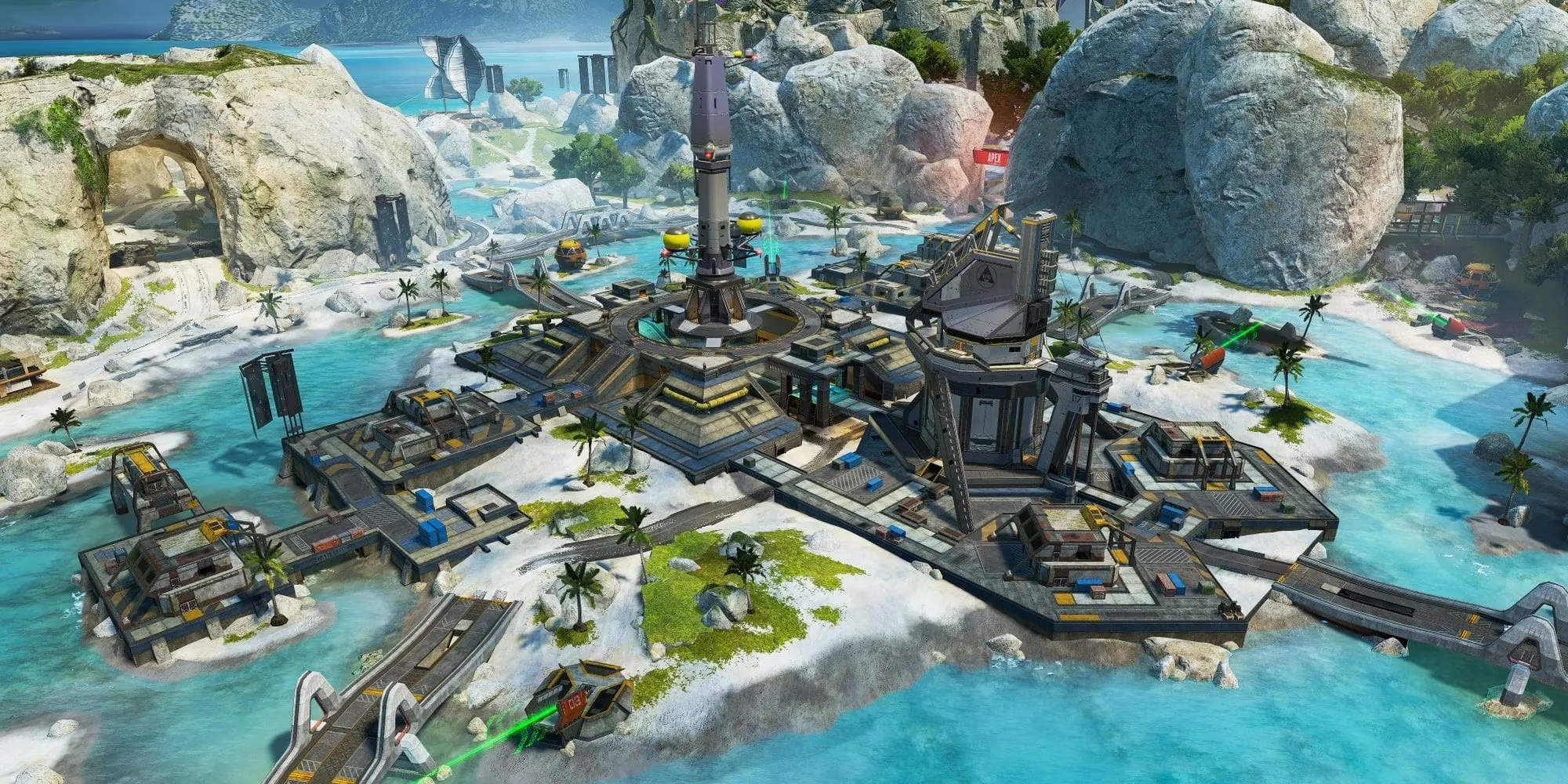
When the sanctions were announced on March 16, 2022, competitors had barely finished adapting their strategies for the newly introduced Storm Point map. Suddenly, they were told that participation in Split 2 of the Pro League would be impossible unless they could prove physical presence in an eligible country by a draconian deadline. An EA email shared by player Elvira ‘Esdesu’ Temirova suggested the cutoff was March 20 – just four days away. The community erupted in confusion. “No warnings, no nothing,” Russian pro Artyom ‘Hisofu’ Frizov told TheGamer at the time, describing how he discovered his ban through a social media post.
The situation exposed a deep fracture between the competitive player base and the realities of sudden displacement. While organizations like Digital Athletics stepped in to host players in Turkey and offer loaned PCs, the logistical nightmare was insurmountable for many. Flight prices soared, visa pathways froze, and for those still in Belarus or Russia, leaving home within a week was not a matter of desire but of impossibility. Hisofu, then competing for Redragon, put it bluntly: “It wasn't an option for us due to financial and ‘in real life’ issues.” His words echoed those of numerous unsigned or smaller-org players who simply had no safety net.
The ban’s ripple effects did not stop at Russian and Belarussian players. Because ALGS rosters in the EMEA region were deeply intertwined, Ukrainian competitors were also caught in the crossfire. With no fully Ukrainian teams and many Ukrainian players sharing rosters with banned teammates, the competitive field was decimated. Natus Vincere’s Ukrainian duo, Oleksander ‘Sanya’ Bokuchava and Dmytro ‘Xron’ Sakharuk, both in Lviv, had to watch their team’s season hang in the balance as their Russian teammate Anatoly ‘Wrugb’ Belousov scrambled to relocate to Turkey. Similarly, Gambit’s Artur ‘Artyco’ Tishchenko found his ability to focus on the game understandably fractured, even though his teammates were already abroad.
The scheduling chaos compounded the damage. After pausing the Pro League, EA crammed six consecutive days of matches into a frantic make-up window – an unprecedented grind that drew criticism for its disregard of player wellbeing. Meanwhile, a wave of withdrawals reshaped the lobby. According to Liquipedia records from the period, teams like Name1ess, dead inside, FIGVAM, Redragon, SSD, UpRising, and VCTRY Esports all had to forfeit their Split 2 slots, a collective erasure of nearly 20 percent of the qualifying field.
In the years since, the ALGS landscape has matured in unexpected directions. While EA never formally rescinded the country-based restrictions, the industry learned hard lessons about player mobility. Grassroots initiatives that sprang up in 2022 – community-funded relocation grants, neutral-host bootcamps in Central Europe, and remote tournament pilot programs – gradually became formalized pathways for talent from politically volatile regions. Hisofu’s own journey mirrored this evolution. After taking a step back from top-tier competition, he eventually resettled in Armenia in late 2023 and returned to the ALGS qualifiers under a new banner, part of a small but meaningful wave of players reclaiming their competitive dreams through legal residency changes.
Looking at the 2026 season, the EMEA Pro League now features robust support structures that its 2022 counterpart could only imagine. Tournament organizers coordinate with regional embassies for expedited travel documentation, and designated “safe lanes” allow players who have been displaced to compete under neutral status without forfeiting their national identity. Still, the memory of half-empty lobbies and frantic social media announcements lingers. Coaches and analysts routinely cite the ban as a catalyst for modern player advocacy, with many contracts now including relocation assistance clauses as a direct response to the “Hisofu moment.”
The legacy of the 2022 bans is not simply one of disruption; it is also a story of resilience. Hisofu, now a veteran IGL respected for his mental fortitude, often tells interviewers that the experience taught him to separate the game from geopolitical noise. “Games always help you distract from reality,” he once said, a sentiment that has been adopted as a mantra by younger competitors who face their own versions of external pressure. While the esports world remains vulnerable to the tides of global politics, the EMEA Apex scene learned that solidarity, planning, and a willingness to adapt can keep a community alive even when the battlefield is no longer virtual.
Data referenced from Esports Charts helps frame how disruptive policies can ripple through competitive ecosystems: when a notable share of teams withdraw or are forced into emergency roster changes, the viewing product often shifts as well—broadcast schedules compress, storylines fracture, and regional depth can thin out overnight. In the context of the ALGS EMEA turbulence described above, tracking event-level performance indicators (like audience peaks, average watch time, and match-day volatility) becomes a practical way to understand not just who was missing, but how the competitive and spectator experience was structurally reshaped.
Leave a Comment
Comments