It was a quiet evening in the Outlands, but the Apex Games never sleep. On the digital forums where Legends are dissected with surgical precision, a familiar lament echoed through the community: whatever happened to Revenant? Once a terrifying presence in squads, the synthetic assassin had faded into the background, his pick rate languishing near the bottom while newer, flashier characters dominated the Arenas. Players who had once reveled in his shadowy theatrics now scrolled past his icon, their cursor hesitating for a moment before clicking on someone more reliable. It wasn't that Revenant was useless—his entire vibe screamed menace—but his ultimate ability, the Death Totem, felt increasingly like a relic from a bygone era.
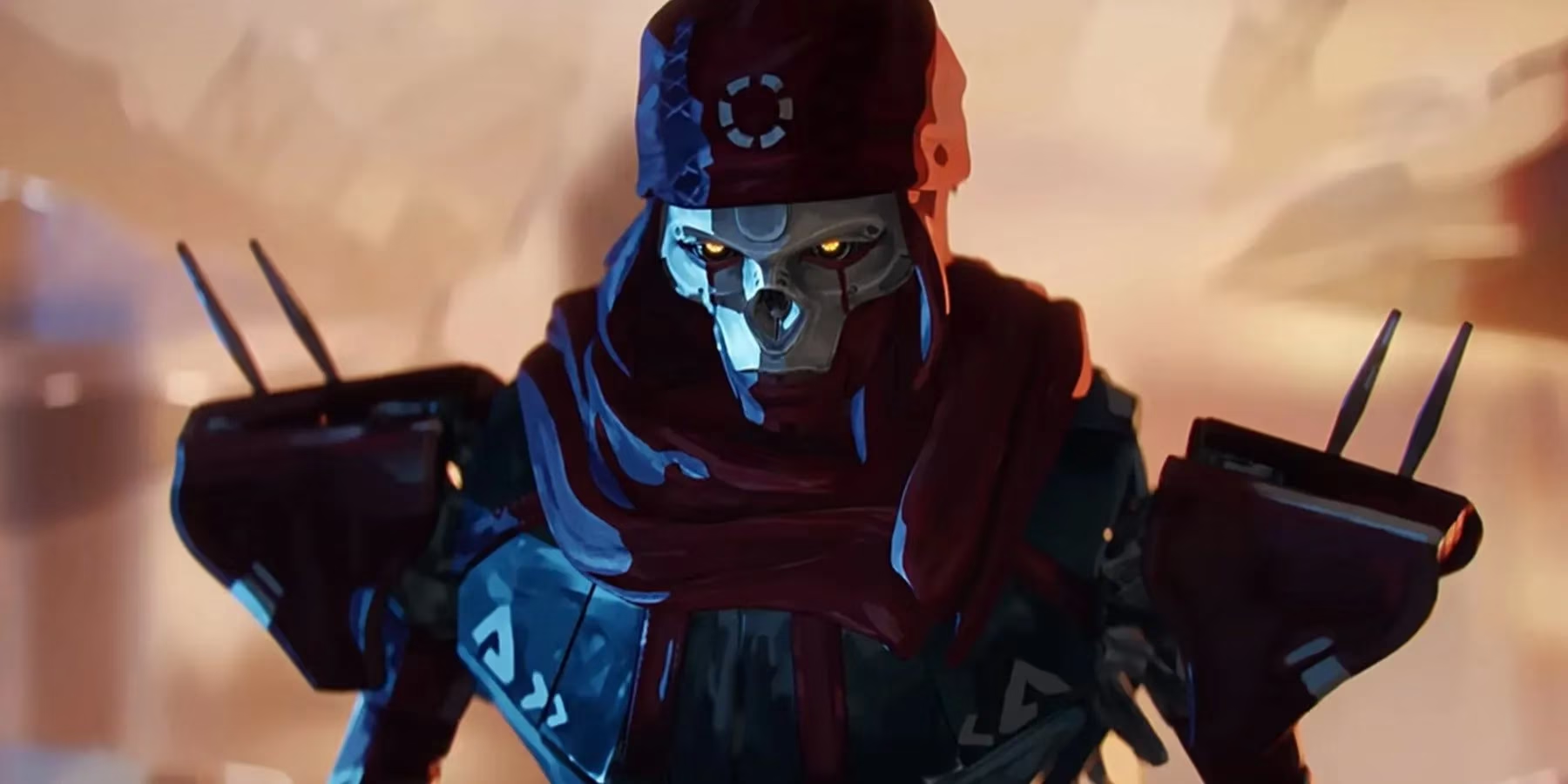
As the seasons rolled on and the meta shifted like desert sands, many faithful Revenant mains began to craft their own visions for a resurgence. They didn't just want a simple buff; they craved a fundamental transformation that would make the nightmare bot feared once more. The most compelling blueprint emerged from a Reddit user known as XxGAMERZxKINGxX, whose proposed rework for the Death Totem sent ripples of excitement through the community. Rather than a static resurrection point, the totem would become a charged ability—akin to Valkyrie's Skyward Dive—that transformed Revenant and nearby allies into spectral shadows. For a fleeting moment, they would receive invulnerability, allowing for a rapid reposition rather than a forced teleport back to a single vulnerable spot.
The beauty of this idea lies in its tactical fluidity. No longer would a squad be yanked away from a critical engagement just as victory seemed within reach. Instead, the shadow form could be used to push through blistering crossfire, escape a collapsing ring, or outmaneuver an entrenched enemy team. The trade-off, carefully balanced to avoid overpowering the ability, would be a brief period after the effect ends where players cannot fire weapons or activate abilities—a vulnerability window reminiscent of Wraith emerging from her dimensional portal. It swaps safety for aggression, turning a reactive tool into a proactive one.
The conversation didn't stop at Revenant. The same hunger for reworks extended to other characters whose utility had dulled over the years. Lifeline, the combat medic, found herself in the spotlight as fans campaigned for a more unpredictable Care Package. One creative suggestion involved introducing red-tier rarity items: unique gear with exotic mechanics, like a Red Knockdown Shield that conjures a protective dome around a downed ally. These discussions underscored a broader truth about live-service games: stagnation is the real enemy. If Respawn wanted to keep Apex Legends feeling fresh in 2026, they needed to look not just at new Legends but at old ones who had been left behind.
Revenant’s plight is a classic tale of power creep and shifting design philosophy. When he arrived in Season 4, the Death Totem was a gamble—high risk, high reward. But as mobility-based Legends soared in popularity and team compositions demanded more dynamic synergy, a static resurrection station lost its luster. The shadow form rework would align him with a faster, more vertical playstyle that defines modern Apex. Imagine a scenario: your squad is pinned behind rocks in World’s Edge, the circle closing, and an enemy Valkyrie raining missiles. Revenant activates his charged ultimate. In a flash, all three teammates become wraiths, sprinting through gunfire to seize high ground. The element of surprise alone could flip a desperate situation into a highlight-reel victory.
Community feedback, while often fickle, has shown remarkable consistency on this point. Post after post on forums and social media echo the same refrain: “Make Revenant scary again.” It’s not just about pick rate statistics—it’s about the fantasy of playing a relentless assassin who bends death to his will. The current totem, for all its theoretical utility, often results in frustrating moments where a revived teammate is immediately downed again or the totem itself is destroyed before it can trigger. The proposed shadow charge circumvents those frustrations, granting agency and a cinematic flair that matches Revenant’s personality.
Looking at the evolution of other titles, the parallels are stark. Overwatch’s reworks of heroes like Symmetra and Torbjörn fundamentally altered their roles and revived interest. Apex Legends has already demonstrated a willingness to overhaul characters when needed, as seen with adjustments to Wraith’s hitbox and abilities over the years. A Revenant rework wouldn’t be unprecedented; it would be a continuation of a healthy design ethos. And with the game now available across such a wide swath of platforms—from mobile to console to PC—the developer has more reason than ever to ensure every Legend has a viable place in the meta.
What makes the shadow-walker idea particularly resonant is how it marries lore with gameplay. Revenant’s background as a simulacrum who was once human, trapped in a metal shell and driven by vengeance, already deals in themes of transformation and otherworldly endurance. Turning his squad into ethereal shadows feels like a natural extension of his tragic, vengeful journey. It also offers myriad moments for tactical creativity: baiting enemy fire, scouting dangerous zones, or coordinating a synchronized ambush that leaves opponents bewildered.
As Season 24 settles into its rhythm, the clamor for change hasn’t diminished. Data miners and insiders haven’t yet uncovered official plans for a Revenant rework, but the conversation refuses to die. Tournaments continue to see him largely absent, and casual lobbies consider him a niche pick at best. If Respawn wishes to honor the legacy of a Legend who once haunted the dreams of Apex competitors, embracing a charge-based shadow ultimate could be the key. After all, in a game where every second counts and repositioning wins matches, giving the synthetic assassin a tool to bend the rules of engagement might just resurrect him from the scrap heap—and remind everyone why they feared the sound of metal footsteps in the dark.
Leave a Comment
Comments